
How BRT Can Build Chicago’s Economy as Well as Improve Mobility

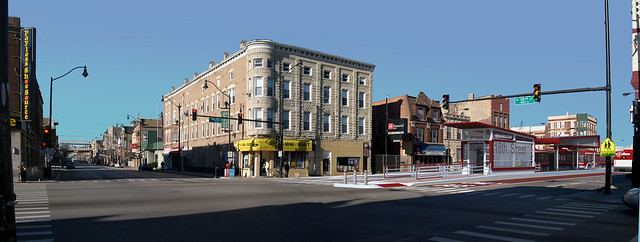
As planning advances for Chicago’s first full-fledged Bus Rapid Transit routes, public officials and advocates are starting to make the case that new, high-quality bus service is about more than getting people from point A to point B quickly and reliably. Those mobility benefits will be significant, but if BRT succeeds at improving transit trips for Chicagoans, it can also bring about a range of other benefits, spurring development and adding new housing choices where people can live without the financial burden of car ownership.
The non-profit Metropolitan Planning Council is undertaking a new study to determine the development opportunities along Ashland and Western Avenues, the two corridors currently under consideration by the Chicago Transit Authority for BRT routes.
The study will identify vacant land, underused parcels, and areas that lack essential amenities like grocery stores. “We want to find out where we can engage the community, neighbors, and developers, and inform them that a new rapid transit line could potentially create greater demand for this land,” said MPC Executive Vice President Peter Skosey, who noted that existing research on the link between BRT and development is scarce. “We found studies from Pittsburgh and Baltimore that showed a correlation between leasing costs and proximity to BRT, but nothing conclusive.”
MPC published a report in 2011, “Bus Rapid Transit: Chicago’s New Route to Opportunity” [PDF], which analyzed existing land uses to determine where new bus rapid transit routes could go. The report identified 10 new BRT routes based on 14 criteria, including “infill development potential.”
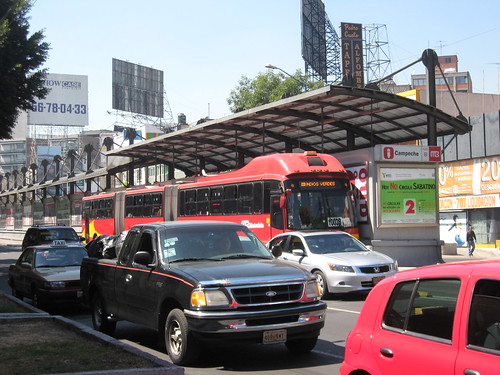
MPC will be working with a finance expert on loan from World Business Chicago, an economic development corporation chaired by Mayor Rahm Emanuel, with much of the work conducted by in-house staff. Skosey explained that BRT is one of World Business Chicago’s primary infrastructure investments.
Developing the land near BRT stations will in turn help the bus routes generate revenue. According to BRT Chicago program manager Chris Ziemann, one lesson planners have learned from Curitiba, Brasil, where BRT was pioneered, is that you can surround the corridor with transit-friendly development that makes running it financially sustainable. MPC will also be exploring ways to finance BRT construction and operations.
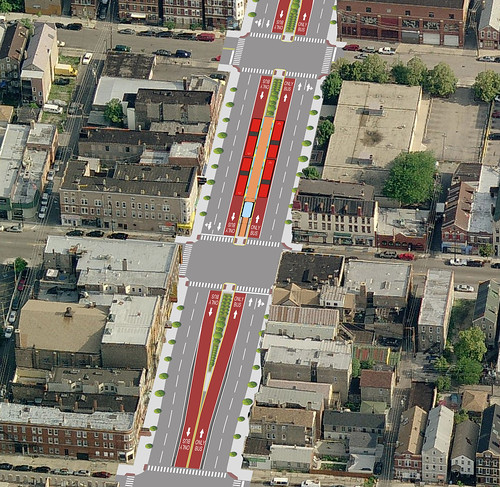
In addition to looking at how to pay for BRT on Ashland and Western, MPC will be looking at “nodes” along the corridors where development can be targeted. With a convenient transit option nearby, adding housing and new businesses in these nodes will help households shed some of the expense of owning and driving a car. (For more on the interaction between transit access and housing affordability, see the Center for Neighborhood Technology’s “H+T Affordability Index.”)
Skosey cited the former manufacturing corridors along Ashland and Western as examples of possible development locations. Many parcels are unused and, with the right incentive – not necessarily a financial one – developers could be drawn to these areas. The hook could be as simple as marketing the locations properly to convince developers that parcels near BRT have greater potential than parcels far away from convenient transit. Look for the MPC to address this question in its study.

Read More:
Streetsblog has migrated to a new comment system. New commenters can register directly in the comments section of any article. Returning commenters: your previous comments and display name have been preserved, but you'll need to reclaim your account by clicking "Forgot your password?" on the sign-in form, entering your email, and following the verification link to set a new password — this is required because passwords could not be carried over during the migration. For questions, contact tips@streetsblog.org.


