
Bad News: Forest City Breaks Bike Parking Vow; Good News: Less Car Parking

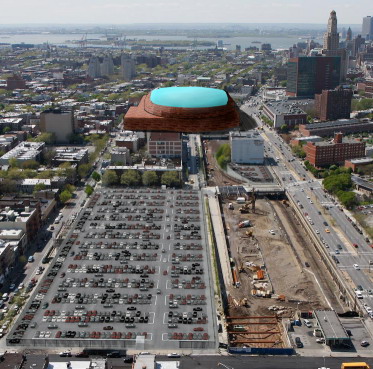
When Brooklyn’s Barclays Center opens with a Jay-Z concert this September, it will be one of the most transit-accessible arenas in the United States. But as Streetsblog has noted before, the transportation planning for the stadium is excessively car-oriented. Developer Forest City Ratner had been planning to build an 1,100-space surface parking lot, marring the pedestrian environment and inducing more driving to the stadium. As opening day nears, there’s good news and bad when it comes to parking.
The bad news first: Forest City no longer plans to keep its much-touted promise to build a staffed indoor bike parking facility in time for the arena opening. Instead, for the foreseeable future, the bike parking will consist of plain outdoor bike racks.
In the December 2009 Atlantic Yards Amended Memorandum of Environmental Concerns, Forest City promised to implement a number of measures “prior to the opening of the arena” to encourage people to leave their cars at home when traveling to the Barclays Center. One of the commitments the developer made was to “provide any ticketholder traveling to the arena by bicycle with free indoor bicycle storage in a secure, manned facility designed to accommodate at least 400 bicycles on the arena block.”
That bike parking, Streetsblog has learned, won’t be available for opening day or anything close to it. Arana Hankin, the director of the Atlantic Yards project for Empire State Development, said in an e-mail that while there will still be room for 400 bikes at the arena, it will be provided via outdoor bike racks for the foreseeable future. The bike parking will be indoors once the project’s “Building 3,” located at the northwest corner of Sixth Avenue and Dean Street, is complete, at which point it will be located in the basement, Hankin said.
There’s currently no public timeline for the construction of Building 3, and Hankin didn’t respond to a Streetsblog inquiry about when the building might be complete. Right now, construction is only scheduled for one non-arena building, at the corner of Flatbush and Dean.
With the larger Atlantic Yards project stalled, it’s impossible to say when the promised bike parking will be provided, except to say not any time soon.
The good news is that the 1,100 motor vehicle parking spaces have been cut in half, to less than 550. As first reported in the Post and Atlantic Yards Report, Empire State Development CEO Ken Adams delivered the update at a meeting with Atlantic Yards stakeholders on Wednesday.
The reduction comes in part because fitting 1,100 spaces on the given site would have required the use of hydraulic stackers, which could have greatly slowed parking lot operations. The smaller amount of parking can be provided on the surface alone. Fewer parking spaces will mean fewer cars on the road and more people taking transit, walking, or cycling to the game, especially once fans grow accustomed to the difficulty of driving to the arena. The urban design implications of filling a whole city block with parking, however, remain essentially unchanged.
The people who run the Barclays Center, to their credit, are trying to dissuade arena-goers from driving with the transportation section of the arena website. Clicking on the home page “transportation” link sends you to the public transit directions. Those who click on the “parking” link get just 13 words of instruction: “Parking at Barclays Center is very limited. We strongly recommend using public transportation.”

Read More:
Streetsblog has migrated to a new comment system. New commenters can register directly in the comments section of any article. Returning commenters: your previous comments and display name have been preserved, but you'll need to reclaim your account by clicking "Forgot your password?" on the sign-in form, entering your email, and following the verification link to set a new password — this is required because passwords could not be carried over during the migration. For questions, contact tips@streetsblog.org.


